SCRUFF PATCH
Michael Thériault
Do I call you “Special Agent McGuire”? Just “Agent McGuire”?
You stare. I’ll go with “McGuire.”
You saw the patch when you and your partner came to … invite me to this …
conversation, is it? You’ll say eventually, I guess. Triangle of land on a corner bounded by my house, my street, and the street that angles uphill behind us. Too small for a house. You know our place now inside and out. Two bedrooms, one bath, garage down, single story up, stucco front hard up against the sidewalk, shallow bay window top floor, like the house next door other side
from the patch, like others from mid-twentieth century in San Francisco. Carla and I got a little when my mom passed, bigger chunk after her dad, and that became down payment for a place in a neighborhood not the best, not worst, where people like us, whose hands actually keep the City running are hanging on while the tech bros have their fun.
You know I’m a Stationary Engineer. I literally keep the lights on, heating and cooling systems going, toilets flushing in an office tower while the tenants dream up ways to make my kind disappear. My wife’s a hospital phlebotomist. Imagine some machine trying to poke a vein. Someone’s imagining, I guarantee, McGuire.
Imagine a machine to have your “conversations.”
The patch didn’t seem a problem when we were looking to buy the house. Just the opposite. No neighbor that side, no wall against ours. The “soil” is pretty much packed fragments of red-brown chert. Nothing much could grow on it beyond the thin scruff of weeds already there, sow thistle, Judean pellitory, wild oats, some California poppies with powdery mildew.
We saw bits of trash even then, flecks of paper white or bleached white stuck in the weeds and chert. I figured – I hoped – winter rains would wash them away. The Ohlone here made arrowheads from chert. Picking bits of paper from fractured chert might not be the same as from a bowl of razor blades, but I haven’t cared to try. I dare you, McGuire, go jam your fingers in there.
So we shrugged and signed the mortgage docs, and Carla and I were homeowners.
When we showed up with the U-Haul to move in, it was like those paper bits had been seeds, and from them had sprouted the only kind of garden that patch could grow, a trash pile, all across it, sidewalk below to sidewalk above and over against the wall of the house and the back yard fence, including plastic bags ripped open where maybe dogs, raccoons, coyotes had got into
them, and bottles both plastic and glass, lots of busted glass. more danger for fingers, McGuire, and a chair lying on its back like it was dead, which it was, because the seat was gone.
Unsure how well you know the City, and I’m sure you’re not about to say if you live here or in some formula ‘burb, in some house with a lawn out front side-by-side with other lawns. On the news I’ve seen that you know Recology, the trash collectors. You cuffed two of their execs, and the City guys, too, and maybe that has something to do with our “conversation.” If you don’t
know, Recology gives a homeowner three cans. They want you putting most things in the blue one for recycling, the green for compostables. The third, the black one, is for trash that can’t go in the others. It has a plastic insert that makes more than half the can unusable. People too lazy or screwed up to divide things between cans or with too much actual trash for the black can, they look for other places to dump it, like the patch. If I clean up what they dump, it goes into our black can, on top of our own trash.
Way too much in the patch for this.
But it had to be cleaned up. First, there was the plain ugliness. Then, what would it do to the value of our house, and our inheritance and signing away thirty years of our lives to pay hundreds of thousands of dollars? And all this while the guys in my building are working to make us unemployed. Lastly, the City has burned down a few times, that’s why on its flag a phoenix is coming from flames, and some of this trash was deepest right against the wood siding on the unstuccoed side of the house, where any spark on the wind from a brush fire in the park uphill, or from some house in the neighborhood, or illegal fireworks on the Fourth or New Year’s, and up goes the pile, and the house, too.
What were our options?
Carla said, “We call the City.”
Seemed reasonable.
You go to the City’s website, there’s nothing up front about trash, but there’s Problems and Complaints, so you click there and next page you find Request Street or Sidewalk Cleaning. Note carefully: Street, sidewalk, nothing about weedy patches of broken chert. Click, and you’re at Response Time, 2 Hours to 21 Days, depending. Sends you to a form, where you choose your trash type. You’ve got Overgrown lot (blight) there, twenty-one calendar days, and right under it, Other loose garbage or debris, twenty-four to forty-eight hours.
But there was a phone number. I wanted to talk to a human, not type for a machine. Guy who answered was polite. He wanted details on the trash. I gave them.
“And the street or sidewalk location?” he says.
“Not street, not sidewalk,” I said.
“Whose property, then?” he asks.
“City’s, I think,” I say. Too small for a lot; who else’s could it be?
“Street address?” he says.
“Don’t know. Next door to…,” I say, and give him ours.
“I’ll check into it,” he says.
I should have asked for his name, a case number, something. Silly me.
A trash pile in a public place is not static. Animals, the wind move it around. And it grows, not like a garden, not a weed; like a cancer.
A day came and went, but nothing and nobody from the City. The pile grew. Another day, no City, the pile was bigger still. Our scheduled garbage pickup was next morning. I stuffed what I could with our own trash into the short-sheeted black can and cheated as much as I thought I might get away with into the blue and green ones. Hardly dented the pile.
No City that day, either, so I got the notion to bring some to the dumpsters at work. You must know Financial District traffic is nuts, McGuire. Parking’s crazier still. So I take the bus. Next few weekdays I filled a black trash bag, not too full, because I could only carry so much, and nothing that stank, obviously, and toted it to Mission Street and onto the 14, with Go-to-hell in my eyes for anyone who gave me a dirty look. The other Stationary Engineers didn’t object, because they’d all used the dumpsters sometimes for their own stuff.
But that cancer of a pile grew.
I wasn’t about to rent a pickup and make trips to the dump on Tunnel every weekend for the rest of my days. Imagine living out your life like that, McGuire.
I called the City again. Woman this time.
“File says we’re trying to determine responsibility for the property,” she says.
“Not mine,” says I.
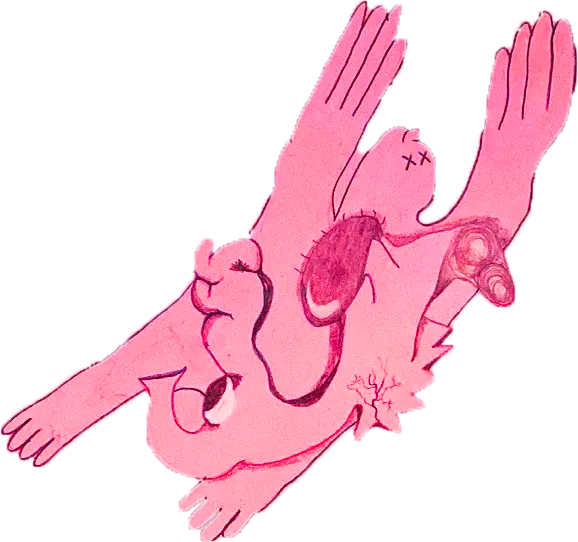
Next day, bigger pile, and now some huge big-eyed filthy pink stuffed animal sitting on a sofa bed. Then it rained for days, and the stuffed thing lost its shape, so it was like a pair of eyes staring from something fungal.
Street sweeper truck comes by once a week, with a flock of parking control officers in three-wheelers. Of course the sweeper wouldn’t touch the patch. But I knew a pickup truck was always out a few blocks ahead to get things too big for the sweeper. Next street-sweeping day I blew a vacation day and waited for that pickup. I moved some of the pile into the street to be sure it stopped.
The City pickup, white Ford, pulls over just past the pile, and a woman bigger than me, brown face, thick black braid down her back, she gets out, pulls a snow shovel from behind the cab, drops the tailgate. When she’s tossing in the first shovelful I ask, “How do I get you to pick that up, too?” and point at the pile.
“Is that the street?” she says.
“No.”
“You don’t.”
“What if I dragged it all out here?” I say.
She stopped shoveling long enough for a quick evaluation of the patch. She says, “Cute. But that’s more than this rig holds, and I have lots more to get today.”
Must have been hell of an expression on my face. I really was feeling defeated. Tough as she looked, she seemed to soften, seeing me. But first I thought she was just going to drive away, because after the tailgate was up she heads for the cab and puts the shovel back behind it and opens the driver’s side door.
Then she does something standing at it. Back she comes with scrap of cardboard, end of a Girl Scouts Thin Mints box, and on the back side a phone number.
“Call him,” she says.
“Name?” I ask.
She smiles. “Goes by ‘Tornado,’ as in ‘White.’”
“Thank you,” I said.
“Don’t, yet,” she says. She’s in the truck and off.
I made coffee and the call.
Guy answers with a plain “Hello.”
“Mr. Tornado?” I said.
He laughs. “Tell me what I can do for you.”
I tell him about my attempts to get the patch cleaned up.
“Yes, it gets complicated,” says Mr. Tornado. “You understand, someone in my position takes risks in assuming tasks like cleanup of your ‘patch’ without clear agency responsibility for the parcel. I – anyone in my position – could be accused of wasting taxpayer money if we took on regular cleanup that’s not clearly our assignment. That’s no way to stay employed.”
“So I’m screwed,” says I.
“Not what I said,” says Mr. Tornado. Somehow I knew not to ask his real name. He says, “It’s just that it will require some thinking, and research and work beyond the usual.”
“What do you need from me?” I asked.
That, McGuire, is the question, if I’d never asked it, this “conversation” wouldn’t be happening. But think: If I had a house in Pacific Heights, Presidio Heights, Sea Cliff – again, undetermined how well you know the City, so I’ll tell you those are wealthy neighborhoods – I’d never have needed to ask. There’d be no haziness over “responsibility.” Any patch of ground didn’t have a clear owner, City would clean it up. Tell me I’m wrong. Certain people don’t pay
taxes like they used to, public budgets get squeezed, services gets cut, and they becomes scarce commodities. Whoever controls the commodity has power. Those who aren’t rich, if we need what the City provides, we have to deal with power. Fact.
“I need nothing from you,” says Mr. Tornado. “While I’m working on it, though, you might make another call.” He gives me a number.
“Who do I ask for?” I say.
“Whoever picks up will be the right guy,” says he. “Just tell him I sent you.”
I thanked him, hung up, made the call.
Another plain “Hello,” no name.
“Mr. Tornado suggested I call,” I said and felt ridiculous saying it.
He laughs, too. “About the holiday party.”
“No,” I said. “Well, maybe,” I said. “Tell me about the holiday party.”
“Hall’s booked, caterer’s lined up. We’d like to make it a little more cheerful. Rum for eggnog, so on,” he says.
“Where do I bring it? How much?” I ask.
Laugh again. This bunch liked to laugh. No lack of cheer, spiked eggnog or not. “We have a supplier and cost-effective arrangement,” he says. Already I pictured that the arrangement involved some cleanup around the supplier’s business. “What we lack,” says this new guy, “are funds.”
“Suggest an amount,” I say.
He did. It was steep, but not unmanageable. And what was the alternative?
Nothing was said, you see, about a quid-pro-quo. But I cut the check right after the call and imagined the tank of eggnog to go with all that rum – you have my registers now, you see how much, the nonprofit it went to – and went straight to the mailbox.
Three days later, time for mail to have been delivered and opened and work assigned, I get home and the patch is clean. Not perfect, mind you, paper bits hung on. But clean.
Do I need to describe to you the personal benefits of a happy wife, McGuire? You married?
Right, none of my business.
Yeah, the checkbook was shared. None of this is on Carla, please. I was the one who talked to Mr. Tornado, and to Laughing Guy. I wrote the checks.
Checks plural, because flowers were needed for a float for Carnaval, hot links for a barbecue for the Fourth, pool noodles and volleyball gear for Labor Day. Trash landed on the patch, trash got cleaned up. I’m sure you have your term for it. I considered it a fee for service. Not up to me to audit if the links or booze or nets or tulips were bought, or at what price.
I have seen the arrests on television, and you there. It’s pretty clear to me which of the cuffed guys you perp-walked was Mr. Tornado, and so his real name, too. No clue about which was Laughing Guy, if in fact you got him.
I propose, McGuire, that your job here is not as shining protector of public confidence in honest government. I cut a check, trash got picked up. There’s a species of honesty in that. But you, you serve that order that chops services we need until they become precious. What does anyone think “run a government like a business” means, or what we risk when we put a businessman in charge? You just serve guys further up the food chain, and maybe they don’t like competition down below, or maybe they’re afraid their own game gets more attention if someone smaller gets people looking.
Maybe someday you’ll see a way you can use what you know, and the position you have, to help make the whole arrangement honest. Long shot, yes? I expect you’ll collect your paycheck, then your pension. Saturdays you’ll mow your lawn in the ‘burbs.
See? You don’t deny you have a lawn in the ‘burbs.
Now if it’s where this “conversation” is heading, you’ve heard what you need, I guess. Here are my wrists. Do that job.
Michael Thériault has been an Ironworker, union organizer, and union representative at various levels. He published fiction in his twenties, half a dozen stories in literary magazines, but abandoned it for decades to support first a family, then a movement. In his recent return, since 2022 his stories have been accepted by numerous publications, among them Pacifica Literary Review, Sky Island Journal, and New World Writing. His story “An Invitation to the Gulls” was shortlisted lately for the Leopold Bloom Prize for Innovative Narration. Popula.com has published his brief memoir of Ironworker organizing. He is a graduate of St. John’s College, Santa Fe and San Francisco native and resident.
← back to features