INTUITIVE ASTROLOGY
Grace McGrade
As long as we’ve had stars, we’ve had stories about what they mean. Some people even think the three wise men from Christianity were astrologers.
TESS POLLOK: You’re an astrologer and you write all the horoscopes for Dazed. What drew you to this line of work? How were you introduced to astrology?
GRACE MCGRADE: I was around 15 when I had my first astrological reading and it changed my life. It was a print-out from astro.com written by Liz Greene, who’s a famous Jungian astrologist. At the time, I was very angry–a total atheist, kleptomaniac, I just sat in my room listening to Odd Future and smoked a lot of weed. It was funny that I didn’t believe in God because I was a very intuitive child who went to Catholic school. Somewhere along the way I just got very angry at the world. But when I got this, this pamphlet about my personality, I just got so wildly excited I was bringing it to school and trying to show everyone.
When I was around 18, 19, I moved to New York and I was doing runway. I was really emaciated and unhealthy, very dissatisfied with my reality. At that point I started seeking, getting really into manifestation and prayer. This was in 2016, pre-Instagram model days, and it was just a scary time to be a model. They had these teenage girls from Russia just walking the runway militant style. Each casting was totally different. I was confronting a lot of existential questions, a lot of life questions about knowing who I was and whether or not I wanted to apply my life force to something that was making me sick and potentially making others sick.
Later, my dad’s ex-girlfriend invited me to stay at this spiritual eco-village called Findhorn in Moray, Scotland. I studied reiki and took a lot of spiritual courses. I was the youngest person there by a lot, like, most of the people there were finding themselves after going through a divorce. I found out that one of my great-aunts had been an astrologer who’d written under a fake name for the Scottish Herald. I found her, she came from a super Irish Catholic family, and she had all these hidden astrology texts stashed away in her home. It was very kismet. That was when I started to really properly study it. When I moved back to LA, purely to renew my green card, I was at a party and doing a few short readings, and that turned into me getting my own office. After I got my own office, I started doing these really intense hour-long sessions with people. People who were going through it–divorce, sexual trauma. Both of my parents are therapists so I kind of had that vernacular to harness, I had a way of giving non-fatalistic non-harmful readings.
POLLOK: I have so many questions. I love that you studied reiki as well, it makes sense for someone who has an interest in intuition-guided healing. Do you see astrology as a technical discipline or more intuitive?
MCGRADE: Both, it’s analytical and intuitive. When I was living in New York, astrology became a really grounding framework for me to read people. But I would say that you could be an astrologer and not be intuitive. You don’t need to be a psychic to read a chart. You need a lot of experience with reading charts, you know, part of the experience is seeing it in the chart and going, “I see this here, how did that play out for you?” So you’re also learning from other people and from their life experience. Whereas with TikTok, and pop culture, you get these fatalistic readings from anyone who has an iPhone. That is not something I could have anticipated when I started out 10 years ago, because no one was talking about it.
POLLOK: How do people benefit from astrology as opposed to regular therapy?
MCGRADE: Astrology is a map of your personal matrix. It’s a birth chart, in many ways it’s an impression of your matrilineal line. It’s your impression of reality at birth. It helps you identify blind spots and recurring patterns; it exists outside of time. Whereas a lot of talk therapy and psychology in general is very diagnosis-driven. In astrology, a planet or a sign can have two sides. Aries can make you act like a go-getter, but Aries can also make you act like a manchild on cocaine. You have a choice in how that energy expresses itself.
POLLOK: What about the history of astrology? Who did you study when you were becoming an astrologer?
MCGRADE: Liz Greene is a big one for me because she works with a lot of Jungian archetypes. Her work is a lot more psychological, less personality-focused. I really like Stephen Forrest even though he was recently cancelled. He has a book about how great astrology also involves being a great historian. It’s about being able to reference certain transits in history and identify what’s occurring at these different points. Steve Brennan is also great at that within Hellenistic astrology. It’s a hodgepodge of study for me. Astrology has always existed across world cultures. It predates Christianity. Some people even think the three wise men were astrologers. As long as we’ve had stars, we’ve had stories about what they mean.
POLLOK: How do archetypes function in astrology?
MCGRADE: A lot of that is based in shadow work and the unconscious. It’s about how we unconsciously project our reality into existence rather than being these, like, innocent bystanders who are perceiving it. Before the age of three, we still exist in this unified field with everything around us because we haven’t developed language. As soon as we develop language, we develop separateness. That’s kind of what a birth chart is. It’s the initial imprint of that unified experience. A lot of trauma happens before the age of three. We’re not able to separate the frequency of abandonment or pain or dissonance from our immediate reality because it’s free of language. Then we go out and repeat something that feels the same over and over again. That’s what you see with Saturn or Chiron, that repeated experience.
POLLOK: Interesting. I’ve been thinking about this a lot, as well, because I’m in graduate school right now studying psychology. There’s a lot of emphasis on family systems.
MCGRADE: That’s a huge part of astrology. You have your sun, your conscious awareness, and your moon, which is your unconscious–but they also represent the archetype of your mother and father. They come together around your Mercury, which is how you speak, and your Venus, which is what you attract.
POLLOK: You mentioned that you’ve helped people who are going through things, like sexual trauma and divorce, with astrology. How do you see it facilitating that?
MCGRADE: I think astrology can help us identify circumstances and recurrent patterns in our lives. Things like recurring themes. When I first read my own chart, I realized that there was a part of me that is, you know, unconsciously recreating this chart. There’s planets that represent your core wound; Saturn can even point to a repeating blockage, something you’ve returned to again and again. Over time, as you grow older, you can overcome a lot of things, but those themes are prevalent throughout the entire birth chart. Again, it’s about the matrilineal circumstances of your personality. What your mother was experiencing when you were born. Astrology is definitely self-help oriented. Making predictions and writing horoscopes is a bit more about contextualizing what we’re going through collectively and trying to let people know the energetic weather. But above all else, it’s the language of energy.
POLLOK: Do birth chart readings tend to be predictive, like fortune-telling?
MCGRADE: There are different kinds of birth chart readings. For one client, I might read a birth chart, but for another, we might just look at transits. That would mean the next three months, next six months, or so on–whatever the transits dictate. Things like that can point to certain initiations or cycles of change, cycles of restriction.
POLLOK: What archetypes do you associate with the signs? I would assume there’s a little of all of them in all of us.
MCGRADE: Aries is the spark of human consciousness to experience itself in the physical. It’s pure possibility, pure potential. It feels very new, but it can have this darker quality where it becomes obsessed with conquest or war, it’s a very masculine sign. Taurus is about seeing all of the possibilities laid out in front of you and deciding which one has value. It’s about developing a relationship with your body, developing taste, connecting to your senses. They’re quite materialistic, quite focused on comfort and safety, but can also be very stubborn. Gemini is about discovery and curiosity. I always think of Gemini as corresponding to our teenage years. Gemini energy is eager to try everything but not commit to anything. Cancer corresponds to the mother and to home. Cancer is this crab, something that has a very soft interior that has developed a hard shell in order to survive. It’s about needing to protect our inner world from the harshness of reality. I associate Cancer with nurturing, victimhood, Lana Del Rey, and nostalgia for the past. Leo is this divine child, or maybe a celebrity king. That’s where we actualize the self and creativity and self-expression. It’s ruled by the heart. Leo is where we’ve decided to just bravely move ahead and assert who we are. In Virgo we have to redefine all that, maybe we’ve been a bit too much or too excessive–Virgo is where we become detail-oriented, or possibly neurotic and obsessive. It’s kind of Patrick Bateman energy. Virgo is interesting to me because it’s the only sign that comes into reality with this awareness that we’re here to grow. Libra is about codependency and beauty, it’s when you meet another person for the first time. Libras have this psychic awareness of what other people want and they’re very interested in fairness, balance, and reciprocity. Scorpio is where we have sex and all bets are off. It’s when you become obsessed with somebody and you don’t know where they begin or you end. Scorpio represents the merging of energy, whether it’s through something like intercourse or trauma or death. Scorpio is a shamanic sign where we see the darker elements of the psyche, control and manipulation and secrecy. Sagittarius restores hope after, Sagittarius uses that meaning to formulate an existential understanding of why things happen. Sagittarius is the sign of wandering, foreign cultures, the sign of faith. It’s where we go to find hope and enthusiasm again. Capricorn is more focused on the material world, more about reputation and integrity. It’s the most involved earth sign. It’s about our responsibility to the public, civic responsibility, wanting to create something lasting, and very business-coded. Aquarius is the rebel and corresponds to the internet. It’s very Tesla-coded, thoughts that come out of nowhere. It’s freedom of information and it’s the water bearer, you know, it’s the person who brings new ideas and new resources for the benefit of the tribe. Then in Pisces it’s just this drunk mystic, the person who’s the furthest and closest to God, the most prone to delusion and the most enlightened. It’s where we’re most attuned to other dimensions.
POLLOK: Is there anything interesting or unexpected that you look for when you’re reading someone’s chart?
MCGRADE: People tend to overlook Chiron, which is your core wound. It’s symbolized by a key and can help you escape self-imposed restrictions of Saturn. Those often manifest in external problems. Instead of reading somebody’s ascendant as their appearance, I like to think of it as their perspective goggles. It’s how they perceive the world, it’s kind of like the video game they’re stuck in. It determines the entire outer wheel of the chart. The north node is an important part of any chart, it’s your destiny and what you’re here to learn.
POLLOK: Do you read someone’s energy when doing a chart reading? Is there a spiritual component?
MCGRADE: It’s spiritual for me. I try to sit with a chart beforehand when I read with someone. It’s difficult when I already know someone because it loses a lot of its shock factor. One of my mentors, Rob, used to tell me to just let the planets speak through me. Just sit with how a certain energy wants to be expressed rather than telling someone who they are. With chart readings, there’s always lower and higher expressions to the planets, so you have to be open to that. Neptune, for example, rules addiction and illusion and deception, but it also rules spirituality and unconditional love. You could have someone with a very strong Neptune influence in their chart, this could be somebody who might have a proclivity for escapism or drug addiction, but might also be a really talented songwriter or someone with a vivid imagination. It’s all about helping people learn how to direct the energies they have access to in the correct ways rather than telling them what’s going to happen.
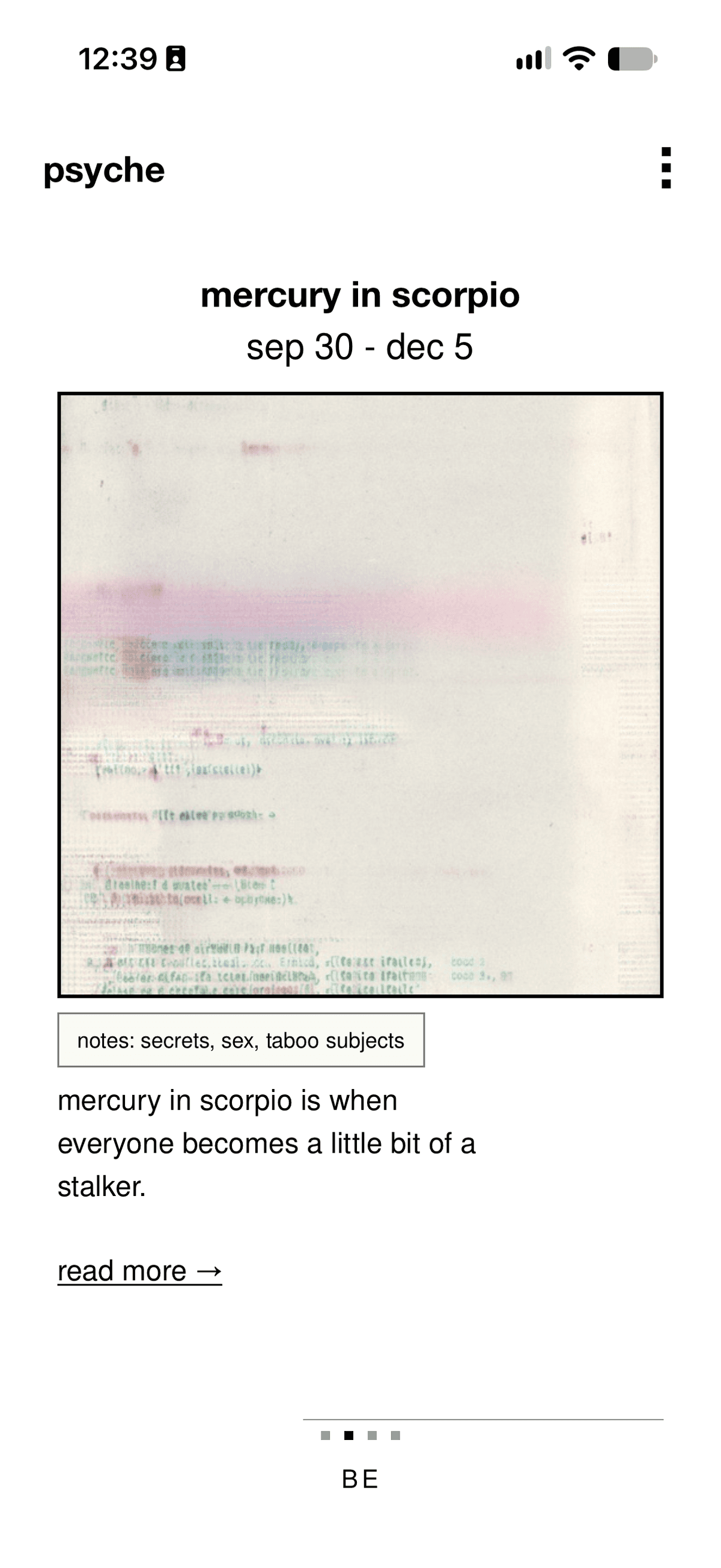
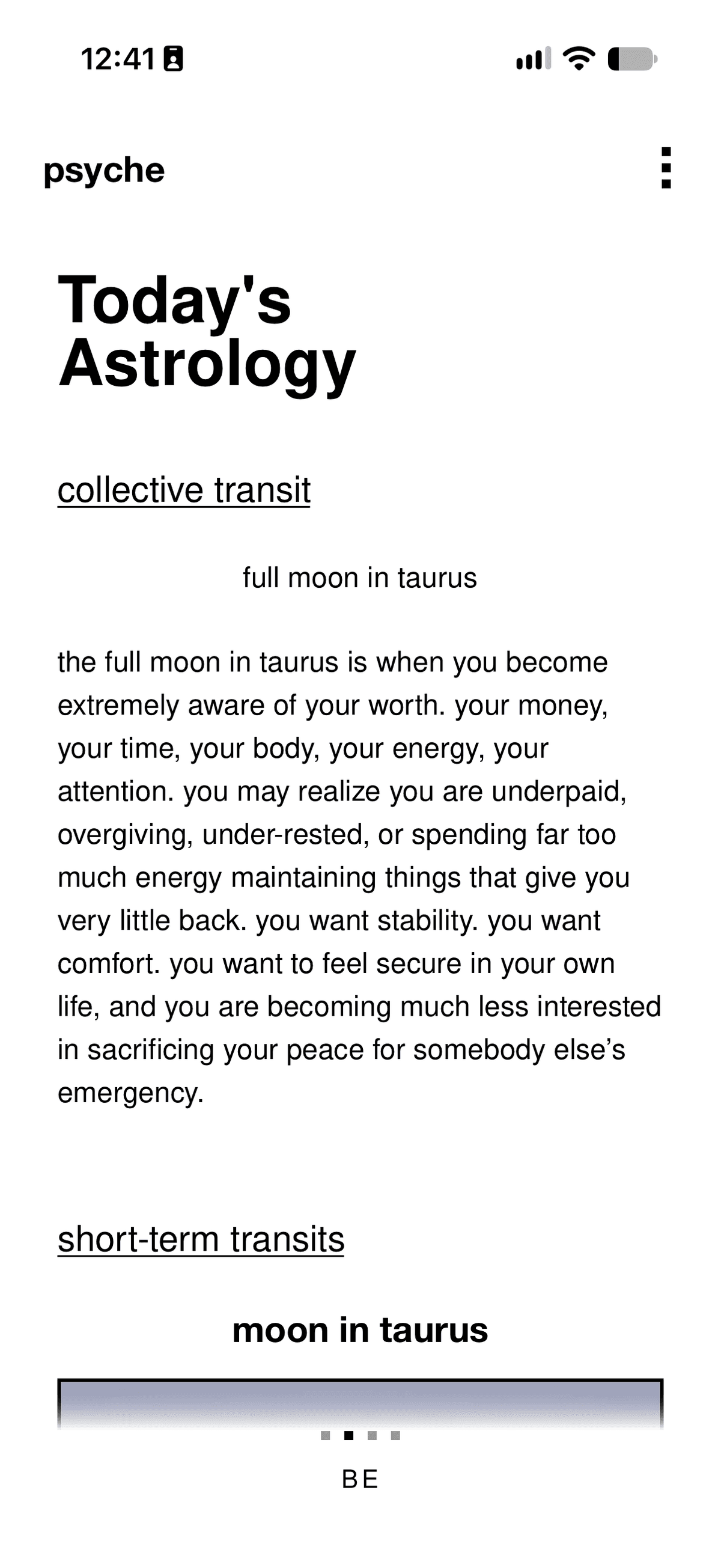
POLLOK: You’re also developing a new astrology app called Psyche. What is that going to be like?
MCGRADE: It’s a new astrology app that isn’t written using AI. It’s written by real astrologers, believe it or not. Co-Star is mostly AI now, which is upsetting. It’s funny to think of my great-aunt, this woman who did this in secret because she believed in it…this is one of the first times in history that it’s just blandly profitable to do this. I want to draw on the study of it and the real practice of astrology. So, it’s all hand-written material from real astrologers and it’s going to be a bit edgier and culturally rich. It’ll have hot takes on culture, some predictions about culture. That’s what I’ve always tried to lean into my astrological writing, not being afraid to consider how certain planetary influences are impacting the zeitgeist. My practice started off with one-on-one readings and now I’m trying to create something that speaks to a wider audience.
The element of history in astrology is fascinating. I was thinking a lot about 9/11 recently; during 9/11, there was a Saturn-Pluto opposition in Gemini, the sign of the twins. Pluto was in Sagittarius, the sign of foreign cultures. I was thinking about how the kids who grew up post-9/11 with this fear of foreigners are getting over their fear of that Pluto. What I love about astrology is that it can give you these poetic portraits of things that can be very difficult. It can help you see the divinity in everything.
GRACE MCGRADE is an astrologer based in Los Angeles who writes horoscopes for Dazed.
TESS POLLOK is a writer and the editor of Animal Blood.
← back to features